


Page 41 - Demo
P. 41
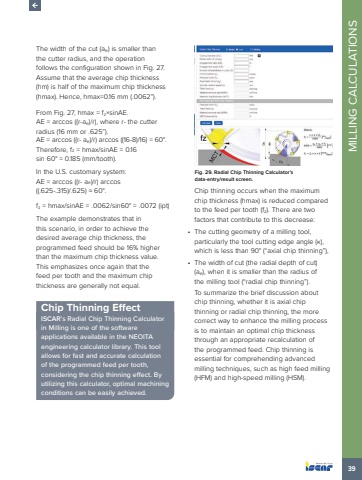
39MILLING CALCULATIONSThe width of the cut (ae) is smaller than the cutter radius, and the operation follows the configuration shown in Fig. 27. Assume that the average chip thickness (hm) is half of the maximum chip thickness (hmax). Hence, hmax=0.16 mm (.0062%u201d).From Fig. 27, hmax = fz%u00d7sinAE.AE = arccos ((r-ae)/r), where r- the cutterradius (16 mm or .625%u201d).AE = arccos ((r- ae)/r) arccos ((16-8)/16) = 60%u00b0.Therefore, fz = hmax/sinAE = 0.16 sin 60%u00b0 = 0.185 (mm/tooth).In the U.S. customary system: AE = arccos ((r- ae)/r) arccos ((.625-.315)/.625) %u2248 60%u00b0.fz = hmax/sinAE = .0062/sin60%u00b0 = .0072 (ipt)The example demonstrates that in this scenario, in order to achieve the desired average chip thickness, the programmed feed should be 16% higher than the maximum chip thickness value. This emphasizes once again that the feed per tooth and the maximum chip thickness are generally not equal.Chip Thinning EffectISCAR%u2019s Radial Chip Thinning Calculator in Milling is one of the software applications available in the NEOITA engineering calculator library. This tool allows for fast and accurate calculation of the programmed feed per tooth, considering the chip thinning effect. By utilizing this calculator, optimal machining conditions can be easily achieved.Fig. 29. Radial Chip Thinning Calculator%u2019s data-entry/result screen.Chip thinning occurs when the maximum chip thickness (hmax) is reduced compared to the feed per tooth (fz). There are two factors that contribute to this decrease:%u2022 The cutting geometry of a milling tool, particularly the tool cutting edge angle (%u03ba), which is less than 90%u00b0 (%u201caxial chip thinning%u201d),%u2022 The width of cut (the radial depth of cut) (ae), when it is smaller than the radius of the milling tool (%u201cradial chip thinning%u201d).To summarize the brief discussion about chip thinning, whether it is axial chip thinning or radial chip thinning, the more correct way to enhance the milling process is to maintain an optimal chip thickness through an appropriate recalculation of the programmed feed. Chip thinning is essential for comprehending advanced milling techniques, such as high feed milling (HFM) and high-speed milling (HSM).


